Saturday, October 10, 2009

So Many Emails Are Nice But Not Necessary

For the first time in months, I just got through all my e-mails. This has been a focused attack this week. I dread starting the effort, but I am glad it's over. There were a few gems in the e-mails, but for the most part it was a quick hit of the delete button.

Several business units report directly into me. They are diverse from our international publishing operations to domestic children's publishing to our digital efforts. I often deal with the issues that really need my attention, which might be 5% of the e-mails I get.

The vast majority of e-mails I can't even get to on a prompt basis of a few days. I guess if I did not want to be involved in my family's life I could, but it turns out that so many of the emails were just "nice-to-be-copied-on".

I have not been commenting on e-mails that ask the multitudes for an answer, even when it's a business unit that reports to me. My thought being that enough others will chime in intelligently. Unless I have something AMAZINGLY important to say, I stay silent. The only problem is that I still get copied on just about every one's response.

I don't have the solution. Our CEO, Mike Hyatt, has had some interesting blogs on the subject, including declaring e-mail bankruptcy.

Well five more e-mails just came in on a Saturday afternoon as I wrote this short blog. They will just have to wait a few weeks. I am going to play baseball with my boy.

Sunday, September 27, 2009

Basic Social Networking Terminology

I spent the last three days at the annual summit of the Society of International Business Fellows (SIBF). SIBF is an organization of about 500 international business executives and owners that share international and domestic business ideas and assist each other around the globe. SIBF has been quite helpful in our efforts to build our business internationally and find suppliers abroad.

A focus of this year's summit was social networking. While these are brilliant business people, especially internationally, Thomas Nelson is ahead of the SIBF members for the most part when it comes to social media and networking. (That unintentionally landed me on SIBF's Social Networking Committee.)

The social media terminology below was shared with the SIBF members this weekend. Even though I believe most of us know these social networking terms, I thought I would share them with you.

Blog - a journal on the Web. Weblogs can be used to improve communication and culture in an organization while enhancing marketing, branding and public relations efforts. Weblogs cover as many different topics, and express as many opinions, as there are people writing them. Some blogs are highly influential and have enormous readership, while others are mainly intended for a close circle of family and friends. A blog entry usually consists of a title, headline, body, post date, comments, tags, and more.

LinkedIn - the world’s largest professional network with over 40 million members and growing rapidly. LinkedIn connects you to your trusted contacts (i.e. SIBF Group) and helps you exchange knowledge, ideas, and opportunities with a broader network of professionals.

RSS (Rich Site Summary) - a format for delivering regularly changing web content. Many news-related sites, weblogs and other online publishers syndicate their content as an RSS Feed to whoever wants it. Users save time by not needing to visit each site individually.

SEO (Search Engine Optimization) - the active practice of optimizing a web site by improving internal and external aspects in order to increase the traffic the site receives from search engines. Firms that practice SEO can vary; some have a highly specialized focus, while others take a more broad and general approach.

ShareThis - a program found on a blog which simplifies and accelerates the online world by making sharing content as instantaneous and customizable as possible.

Technorati - an Internet search engine for searching blogs. Technorati looks at tags that authors have placed on their websites. These tags help categorize search results, with recent results coming first.

Twitter - Social networking and microblogging service utilizing instant messaging, SMS or a web interface. Twitter enables its users to send and read messages known as tweets. Tweets are text-based posts of up to 140 characters displayed on the author's profile page and delivered to the author's subscribers who are known as followers. Twitter is used by organizations and individuals to quickly and effectively communicate news and information.

Wiki - a piece of server software that allows users to freely create and edit Web page content using any Web browser. Wikis have become an effective and popular means for organizations to collaboratively increase communication efforts amongst its associates and members.

Facebook - a global social networking website that is operated and privately owned by Facebook, Inc.[1] Users can add friends and send them messages, and update their personal profiles to notify friends about themselves. Additionally, users can join networks organized by city, workplace, school, and region. The website's name stems from the colloquial name of books given at the start of the academic year by university administrations with the intention of helping students get to know each other better. (From wikipedia)

What other basic social networking terminology should be added to the list above?

Monday, August 31, 2009

DigiReady Update

Two weeks ago we completed the first two DigiReady training seminars. We trained 16 freelancers and 11 additional internal editors for a total of 15 trained internal editors. We surveyed them, and the results are overall positive. The general findings are:
  1. Being 100% DigiReady is critical to our future
  2. We are far ahead of our competition
  3. DigiReady will increase our sales
  4. DigiReady will streamline our processes
  5. DigiReady will improve our quality
  6. Need to train other freelancers working with editors
  7. DigiReady is going to put additional pressure on editor's limited time

The final point #7 is not a surprise. It does put additional time pressure on our editors. Through the numerous DigiReady pilots, however, we have learned that DigiReady gets noticeably easy after about three titles. Like most things in life, there is a learning curve. And, the DigiReady team is looking for ways to always improve the process.

#6 we will be addressing with an additional training seminar in November for freelancers. We are finding most freelancers see the DigiReady training as a way for them to be more valuable to Thomas Nelson and other publishers, which they are!

Nelson editors...don't forget about the follow up internal training on November 10. Not only is it a chance for us to get together and discuss issues, but you can win prizes!! We will have $50 gift cards for the winners of certain categories and a grand prize of a new Kindle 2 for the editor that we feel best utilizes the DigiReady process. The categories are:

  • Most MSS
  • Most Accurate MSS
  • Most Complex MSS
  • Best Success Story
  • Worst Nightmare Story

Again, a big thanks to our hardworking editors and freelancers for making Nelson a publishing leader.

Friday, August 28, 2009

Mobile Device-Agnostic Marketing

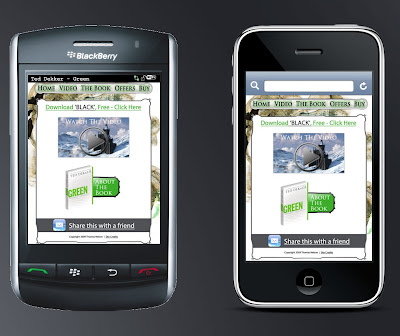
Like thousands of others, we are racing down the iPhone app freeway trying to figure out if Iphone apps make sense for us. We have several pilots underway. And the iPhone is just one device; there is the issue of the other PDAs. Will we eventually make apps for all of the other PDAs too?

I like my iPhone. I have been bothered, however, about making apps for a device that has a relatively small market share compared to all the other PDAs that have Internet access; never mind the total cell phone population. Jennifer Deshler, Senior Director of Marketing for our fiction books, may have come up with an interesting solution.

On September 1st Thomas Nelson will launch Green by Ted Dekker. Jennifer will be launching a mobile site that will work on all Internet-capable devices, such as the iPhone, Blackberry, iPod Touch, tablets, computers, etc. Fiction will be driving traffic to the site through radio/advertising efforts. The week of September 7th, our Fiction division will be offering a full free download of Black (all epub formats or a pdf) to anyone who enters the mobile site and provides their email address.
Jennifer appears to have done a lot of things right:
  1. Clearly defined customer need – Dekker Tribe wants to be first in the know
  2. Why the customer would visit our site – Learn about Green; get a free copy of Black
  3. How to drive site traffic – radio and other advertising

In addition, Jennifer has put in place a series of metrics to monitor the results of this effort, including Google Analytics.

We should know if the next month or so just how well this works. My hats off to Jennifer and the Fiction business unit for their creativity.

Tuesday, August 25, 2009

The Apple Snobs

By most measures, Apple makes some great products. Their customers are amazing fans. The Apple tribe tells everyone about the greatness of their products. As an owner of an iPhone, I get it. Apple has made “WOW” products, and is reaping the benefits from truly great innovation.

Like most energized tribes, however, there is a sub-tribe of irritating snobs; almost elitist. These folks get on a band wagon, which they of course did not start, and they tell everyone how great their new product is, but then they just can’t help themselves….They have to criticize and/or belittle those who don’t have their Apple product.

This is short sighted on several levels, and I don’t need to spell out why. In fact, if you don’t get why that is short sighted, you can pretty much count yourself in the elitist Apple-snob sub-tribe.

There are valid reasons for not having an Apple product. Sometimes it is budgeted related; especially in these hard times. What someone has works pretty well and gets 99% of the job done just fine. Other times it’s preference. I know some business people that have found an iPhone is not the best solution for them.

Apple makes some great products; no question. Are you as classy as the products?

Wednesday, August 19, 2009

Google Publishing Lawsuits Miss Key Point

It is interesting to watch the opposition authors and their agents are having to the Google settlement. There are lawsuits and threats of lawsuits despite this being a much vetted agreement by several leading industry groups representing nearly all interests.
Most don’t understand it, as they have not read the agreement’s hundreds of pages and then they still may not understand it. Frankly, many of us publishers in the industry don’t get it 100% either. We are all a bit ignorant and perhaps even a little scared at least with one aspect of Google, as I indicated in an earlier post.

Regardless of the ignorance, there seems to be one major point that all of these folks talking lawsuits seem to forget….books are becoming less relevant and content on the Internet is becoming more relevant every single day.

You would have to be wacko crazy to not want your books present on Google today. Tim O'Reilly said, “The enemy of authors isn't piracy, it's obscurity.” Google is one of the best ways for authors and their important messages to avoid obscurity and have an impact.

Oh…and authors will sell far more books with a presence on Google, which is what this is really all about any way…$$$$$.

The bottom line is that less people want their content in books. The model is changing and the old guard hates it; this is NOT what they signed up for. Most of them will not be the content creators, representatives, producers and distributors of the future.

What say you?

Tuesday, August 11, 2009

Digital Leadership

On July 23rd I posted a blog titled R U DigiReady? The blog discussed what DigiReady means, and why we are implementing the DigiReady process at Thomas Nelson. As the post indicates, this is why we are training our folks on DigiReady:
  1. Increase Sales
  2. Reduce Cycle Time
  3. Improve Productivity
  4. Better Marketing

DigiReady will allow us to simultaneously launch product in multiple formats, print and digital. If you have any questions about the explosive growth of e-books, check out Michael Shatzkin's latest blog. In some cases over 35% of Amazon sales of a book are the e-book format. Apple, among others, is about to enter the market with their own device. We can't be DigiReady fast enough.

Next week we begin training our freelancers and editors on how to create DigiReady products at Thomas Nelson. We are training 16 outside freelancers and 14 internal editors. (That’s in addition to the four internal editors already trained.) Please support them as they learn this new process. Like any change, it takes some time to become the new standard operating procedure. There will be bumps along the way, and we will work through them.

We have completed 14 DigiReady pilots to date. This is what our editors are saying about DigiReady:

“This DigiReady process is the best thing we could do to protect the life of a book. We want these words to reach as many people as possible; this is a simple, easy way to make sure that happens.” Jennifer McNeil, Editor, Nonfiction Trade Group

"Just ask yourself, what will publishing look like in one hundred years from now? For Thomas Nelson to thrive then and now, digitally-ready content is the ceterpiece of good business, good stewardship, and good strategy." Bryan Norman, Senior Editor, Non-fiction Trade Group

“One of the biggest benefits of making our documents DigiReady is that it enables the elements of the manuscripts to be thought out more thoroughly before they go to Book and Graphic. This structure should really enhance our communication with Debbie and her team on the front end of our process and cut down on style issues with our proofs.” MacKenzie Howard, Editor, Children's Books and Education

“Electronic publishing is an important part of the Bible reference market today, and it will only become larger in the future. Creating really useful electronic versions of our backlist books and Bibles—files with active links for Bible references for instance—currently requires a lot of work for each electronic platform we want to use. The DigiReady process will minimize the duplicated work and produce files that work on a variety of devices with little additional editorial effort.” Michael Stephens, Ph.D. Acquisitions Editor - Bible, Reference, and Curriculum

Thanks in advance to all the Thomas Nelson editors and freelancers that will be learning DigiReady. Your efforts will place Thomas Nelson on the leading edge of publishing today.